The changing names on the screen
New studios. New techniques.
A continuing imagination.
The familiar worlds began with teams of people solving unfamiliar problems. Follow selected chapters in the production story, from early puppet programmes to live action and digital animation.
These are production eras and screen credits; the names sometimes overlap. The thread is the creative work and the people who carried it forward.
1950s beginnings
From Pentagon to AP Films
After early work at Polytechnic, Gerry Anderson and cameraman Arthur Provis formed Pentagon Films. Its commercial and television work helped attract writer Roberta Leigh, leading Anderson and Provis to establish A.P. Films for The Adventures of Twizzle. Torchy the Battery Boy and Four Feather Falls followed, as a small team learned how to combine puppets, cameras, design and storytelling at production speed. Sylvia Thamm (later Sylvia Anderson) and Reg Hill were among the collaborators around the early company. Provis left in 1959, while AP Films continued under Anderson.
Inside the production
Arthur Provis was both an early business partner and a director of photography. AP Films took its name from Anderson and Provis; the studio’s story continued after Provis’s departure.
1960–1966
AP Films finds its signature
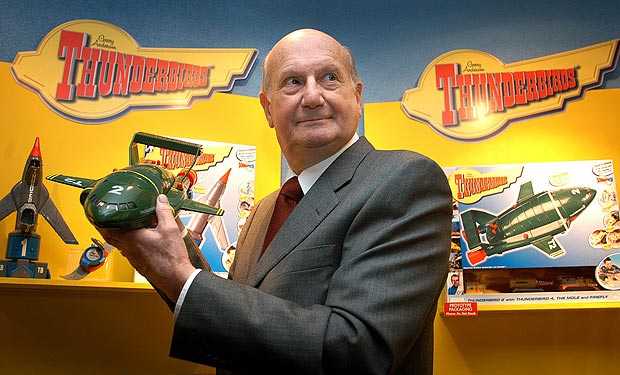
AP Films moved from fantasy westerns into a run of increasingly ambitious science-fiction adventures. Supercar, Fireball XL5, Stingray and Thunderbirds turned miniature craft, electronic puppetry, music and visual effects into a recognisable production language. Gerry Anderson led the productions with a remarkably inventive studio team, while Sylvia Anderson helped shape casting, characters, costumes and the worlds around them. Designers, cinematographers, puppeteers and effects artists made every model, set and movement carry the energy of a much larger universe.
Inside the production
On the 1960 feature Crossroads to Crime, Gerry Anderson was producer and director, John Read director of photography and Reg Hill art director: a glimpse of the different crafts working within the early team.
1967–early 1970s
Century 21 and a bigger screen
As the Supermarionation worlds grew, the production identity became Century 21 Television Productions. Captain Scarlet and the Mysterons, Joe 90 and The Secret Service carried forward the studio’s appetite for bold design, precise miniature work and distinctive character voices. Century 21 also reached beyond children’s puppet adventure: UFO brought the Anderson team into darker live action, with SHADO, elaborate spacecraft and a new visual mood. The company name became part of a wider creative language spanning television, fashion, publishing and cinema.
Inside the production
UFO’s credits include “Century 21 Fashions by Sylvia Anderson” and Reg Hill as producer. The costumes, interiors and miniature effects all helped make SHADO’s world instantly recognisable.
c. 1973–1975
Group Three reaches for space
When Century 21 had disbanded, Gerry and Sylvia Anderson regrouped with producer Reg Hill under the Group Three banner. Their first-season Space: 1999 carried the Anderson imagination into live-action space drama: Moonbase Alpha, industrial spacecraft and a crew thrown beyond Earth’s orbit. The series joined practical design, miniature effects, international ambition and a more serious dramatic tone. It marked a new chapter in scale and subject while retaining the collaborative craft that had powered the earlier puppet productions.
Inside the production
The first-season production record brings together Group Three, ITC and RAI, with Gerry Anderson as executive producer and Sylvia Anderson as producer. It is a useful reminder that making a programme involved several kinds of partnership.
1983
Anderson Burr’s new kind of puppet
Terrahawks brought Gerry Anderson together with Christopher Burr for a fresh kind of puppet production. Instead of the familiar strings of Supermarionation, latex hand puppets operated from below gave the characters a different physical rhythm and comic energy. The 39-episode series combined expressive performances with miniature craft, sets and effects, creating a future defence force led by Doctor Tiger Ninestein. Anderson Burr Pictures and LWT supported a production that looked back to Anderson’s miniature worlds while experimenting with a new technique.
Inside the production
The official record names Gerry Anderson and Christopher Burr as creators and producers, with Bob Bell as associate producer. The puppet technique became known as Supermacromation.
2003–2005
Captain Scarlet returns in CGI
New Captain Scarlet reimagined Spectrum for a digital production age. The series carried Gerry Anderson’s interest in puppetry and futuristic action into CGI and Hypermarionation, bringing Captain Scarlet, Captain Black and the Mysterons back with a new visual language. Its production credits name Anderson Entertainment, Gerry Anderson Productions and The Indestructible Production Company, with the programme produced by Anderson Entertainment for Gerry Anderson Productions plc. The project connected a classic world to contemporary animation craft while retaining its central conflict and indestructible hero.
Inside the production
Gerry Anderson was series creator and producer, David Lane supervised direction and Ron Thornton was CGI producer. Anderson Entertainment was already part of Gerry’s production story, years before it continued his legacy after his death.